



Plan B isn’t just a Swiss bank account or a property in Spain. It is a pre-planned and well-thought-out scenario for diversifying risks, spreading your assets across several countries, and ensuring a safe background for you and your family.
The purpose of Plan B is to ensure predictability, stability and the ability to manage and access assets even in the event of abrupt adverse changes in the economy, legislation, or society as a whole.
Pandemics, armed conflicts around the globe, and the geopolitical changes of recent years remind us that it is not just a question of how much family wealth you have, but also where you hold it, where you can access it from, and whether, in the event of unexpected circumstances, you and your family are able to relocate legally and swiftly to another suitable destination and have the necessary background in place there. Just as you do not rely on a single type of asset in an investment portfolio, it makes sense to diversify larger assets across different currencies, financial markets and geographical regions. And to have a Plan B ready in advance.
Plan B is particularly important for entrepreneurs and families whose assets and lives are still largely tied to one specific country. A typical example is a company owner who has built up a successful business, bought several properties and holds virtually their entire wealth in Czechia and in Czech crowns. But it also makes an equal sense for a family that has just sold its business and is facing a completely new situation: where to invest the proceeds, how to divide and protect their assets, and how to eventually pass them on to their children and future generations.
Plan B is indeed a natural part of protecting the assets of families that are already active internationally. The children are studying or working abroad, the parents own property in multiple countries, or their company is expanding into new markets. In such a situation, it is no longer a question of an “escape plan”, but rather the logical continuation of the global way of life.
A comprehensive preventative plan makes generally sense for assets worth around five to ten million euros, i.e. approximately 125 to 250 million crowns. A simpler solution focused on a single destination is worthwhile from two to three million euros. For assets worth more than 25 million euros, international structuring is now standard practice. What matters is not just the value of the family’s assets, but also where the family runs its business, invests and lives.
Money must be accessible, not just well invested
The first part of Plan B concerns money. In a crisis, it is not enough simply to have your assets well invested – you also need to be able to access them quickly should a crisis arise. Plan B therefore typically involves a globally diversified portfolio spread across multiple regions, currencies and asset classes, including investments in private equity and real estate. The aim is not to move everything abroad, but to minimise the risk that a single event could affect a significant portion of the family’s wealth.
It is essential to hold accounts with foreign banks that have a global reach and to be an established client with them. Banks carry out thorough checks on new clients, verify the source of their assets, and bankers want to get to know them in person – and the whole process can take weeks or even months. That is why it is essential to address this well in advance.
A second home that is a real home
Money is one thing. Plan B, however, also addresses where you and your family would actually go if necessary, that you could stay there legally, have a background there, and be able to actually live there. There is no universal “best” destination; there are many suitable ones. We recommend always choosing a location based on the specific circumstances of the family, their assets, business, lifestyle and priorities. One factor, for example, is whether, as a business owner, you need to remain within reach of the European business, or whether you can relocate to the other side of the world. How old your children are, in which parts of the world you already have investments, and a number of other factors.
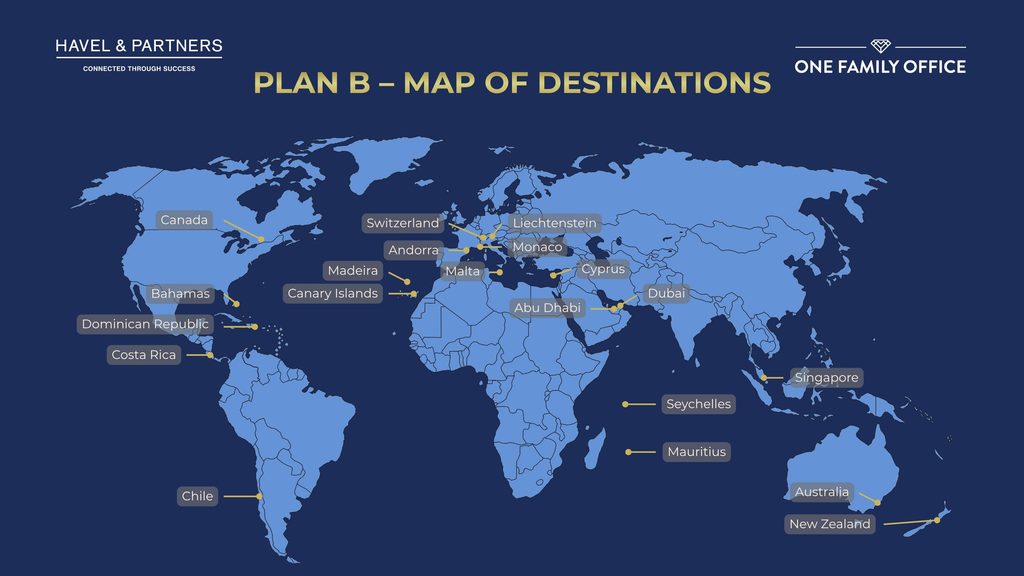
But choosing a country isn’t the end of the planning process. You will need to sort out accommodation, how to get there in the event of a crisis, and the practical arrangements once you arrive. If you have school-age children, find out whether they can easily continue their education in your new location. It is also advisable to check in advance that high-quality healthcare is available.
Have your documents ready
It is not enough just to have somewhere to go; you also need to be allowed to stay there. Depending on the destination chosen, it is therefore necessary to address visas, temporary or long-term residence or another form of residence status. This process, too, can take months. You should be aware of the conditions under which you can enter the country, how long you are allowed to stay there, and what you need to do to be able to function there effectively.
Keeping your documents in order is also part of the preparation. Birth and marriage certificates, proof of education, bank account statements, vaccination records and other important documents must be officially certified, translated into English and stored securely – ideally outside your home country as well.
Assets need a solution that can cope with change
Moving abroad does not necessarily mean moving all your property. It is important to ensure that the ownership is arranged in such a way that you can continue to manage it even if you start living in another country. One of the most crucial elements of plan B is a properly structured asset portfolio. The structure is typically based on a holding company, supplemented by a trust, a family endowment fund or a foreign trust to protect the family’s wealth from external interference – be it geopolitical risks, legal disputes or unexpected legislative changes.
A well-designed domestic structure enables you to actively manage your assets, allocate them according to clear rules and meet your family’s needs. Given the scale of their overseas business operations or international assets, many clients may also find it interesting to set up trusts in one or more of the traditional jurisdictions. We often arrange this for them in places such as Liechtenstein, Switzerland, Jersey, Guernsey, the United Arab Emirates, Singapore, the United Kingdom and certain US states. It always depends on the specific circumstances of the client in question. Thanks to our long-standing and close collaboration with local specialists, we are able to offer comprehensive international solutions.
Tax residence cannot be changed overnight
Moving one’s life to another country always has tax implications. Plan B therefore includes scenarios for changing tax residence and prepares the family for long-term life in another jurisdiction. However, tax considerations should not be the main motivation; Plan B is being drawn up primarily to ensure predictability, stability and the ability to manage assets properly, even in the event of significant adverse changes in the economy, legislation, or society as a whole. The legal, investment and tax aspects of the plan must therefore be developed as a single, integrated whole.
The hardest part? Start in good time
All parts of Plan B are linked by one common factor, and that is time. A foreign bank needs to verify a customer’s identity. Someone must approve the residence permit. You need to structure your assets and get to know the destination before it becomes your new home. As soon as accounts are frozen, capital controls are imposed or visa issues arise, the options narrow dramatically. That is why Plan B is drawn up during peaceful times and in stages.
FAQ
What is Plan B for protecting your assets and family?
Plan B is a strategic contingency plan for protecting your family and property in the event of unforeseen circumstances. It addresses the spread of assets across several countries, access to financial resources and the possibility of moving part of one’s life abroad.
For whom does Plan B make sense?
Primarily for businesspeople and families whose assets and lives are largely centred on a single country. It also makes sense for families who are already doing business, investing or living internationally and need to manage their assets in a global context. A comprehensive scenario generally makes sense for assets worth around five to ten million euros, whilst a simpler option is viable for assets worth two to three million euros. For assets worth more than 25 million euros, international structuring is standard practice.
What should Plan B include?
Plan B is based on four main pillars: the financial aspect (foreign accounts, a diversified portfolio), the legal aspect (holding structures, residence permits), the tax aspect (scenarios for changing tax residence), and the practical aspect (background for the family, documentation, logistics).
How to protect assets against crises?
The key is not to concentrate all your assets in a single country, currency or asset class. It is essential to ensure immediate access to liquid assets and to structure the ownership appropriately – whether through a holding company, a trust fund or a family endowment fund, or a foreign trust.
When to start drawing up Plan B?
Ideally, at a time when there is no immediate threat of a crisis. Opening a foreign bank account, obtaining a residence permit and setting up an asset structure all take time – ranging from weeks to months. In a crisis situation, options may already be significantly limited.
Key contacts:

Jaroslav Havel
Managing Partner of HAVEL & PARTNERS and ONE FAMILY OFFICE
Founder and managing partner of the law firm HAVEL & PARTNERS and the family office ONE FAMILY OFFICE. He specialises in providing comprehensive consultancy services in the field of development and strategic management for family-owned and other leading Czech and Slovak privately-owned companies, with a particular focus on succession planning, wealth management and the protection of assets and investments.

Ondřej Florián
Partner
Ondřej has long specialised in advising private clients, particularly entrepreneurs, owners of major companies and their families. He specialises in family endowment funds and trust funds, trusts, holding structures and other solutions for the protection, management and intergenerational transfer of assets. He is also involved in designing Plans B.

Štěpán Štarha
Partner
Štěpán specialises in advising private clients in the Czech Republic and Slovakia on the management and legal protection of assets and their intergenerational transfer. He assists with setting up asset structures, including family endowment funds and trust funds, and also specialises in drawing up Plans B to protect families, wealth and businesses in the event of unforeseen circumstances.